Mindset Maths
Topic outline
-

-
Click on the pictures of Carol and Jo to find out more.


This course is supported by Education Scotland’s Enhancing Professional Learning in STEM Grants Programme through the Scottish Government STEM Education and Training Strategy.
-
Course introduction
Welcome to your Mindset in Education course. You'll be part of an online community where you can share ideas and thoughts about the concepts in this course. Whilst the benefits of having a growth mindset are widely recognised (we'll explore this further in the course), in reality it's not always easy and you may encounter challenges. Implementing a growth mindset culture in your school may require changes to occur. These changes may be to your leadership style, how teachers teach, the learning environment and importantly, the school culture. Making changes such as these is not always easy – this course is designed to help you implement a sustainable growth mindset culture within your school.
At Winning Scotland (www.winningscotlandfoundation.org) we passionately believe that having a growth mindset is critical for young people across Scotland to achieve their best in life and fulfil their potential.
This mindset, researched by Stanford University Professors Carol Dweck and Jo Boaler, helps young people to create a love of maths, thrive on challenges and build resilience when things go wrong. A growth mindset is something that children can learn, but there's also a key role for parents, teachers, and other adults in a child's life to play in ensuring they create a growth mindset environment.
About us
This course was developed by Winning Scotland, in partnership with Education Scotland, YouCubed, Renfrewshire Council, North Lanarkshire Council and South Lanarkshire Council.
Course requirements
You'll require internet access and be able to make a time commitment to work through the online materials, undertake work within your setting and share and reflect on your experiences with the rest of your cohort online – we'll also need your ongoing feedback about your learning experience.
As part of your package of support we'll provide advice about any practical challenges you may face as you work through the course.
Timescales
You're able to work at your own pace, however it's estimated that you'll complete the course learning within six months, with another six months to implement your project. It's estimated that you'll be required to spend around two-three hours per week on the programme, although you'll cover more of this when you complete your learning plan.
Support
This course has a range of different support mechanisms. As part of an online cohort you'll be supported by others in a similar situation to yourself, however you'll also have a role to support others within your cohort. You'll also be supported by members of the Mindset in Education team. This may be online, via phone calls or face-to-face meetings.
As you work through the course, you'll develop a knowledge and understanding of how growth mindset affects a young person’s ability to improve at maths, followed by an in depth understanding of how to lead change in your school. This will be facilitated through the following learning intentions.
- Demonstrate a critical understanding of growth mindset principals, concepts and theories, and the impact on national policy priorities, ensuring excellence and equity for all children, young people and families across Scotland.
- Critically analyse your school / organisation to apply cultural and organisational change that facilitates the development of a growth mindset environment.
- Identify, conceptualise and define the potential barriers to change.
- Critically examine mindset behaviours and professional practices (that contribute to a growth mindset environment) and understand the impact this has on staff.
- Understand your role as a change leader and have the ability to demonstrate the desired requirements and behaviours to lead and manage change.
- Critically review the effectiveness of change tools and strategies to improve the outcomes for people involved in, and going through, change.
Since the visit of Professor Carol Dweck (the lead researcher of growth mindset) to Scotland in 2014, followed by the visit of Professor Jo Boaler in 2018, Winning Scotland has been working with Scottish Government, Regional Improvement Collaboratives, local authorities, schools and educators to raise the awareness of growth mindset principles and also to develop and share practices that allow the effective application of these principles in a classroom setting.
To do this we apply a team approach. Each team consists of at least:
- one member of the school's senior leadership team (Mindset Leader)
- two members of teaching staff (Mindset Champions)
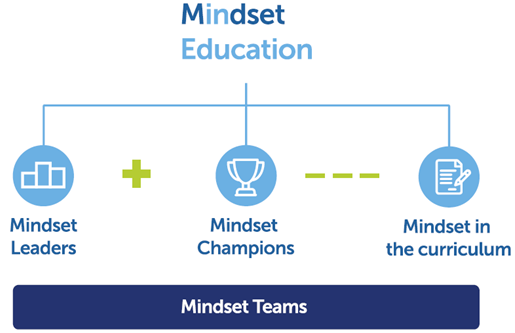
It's this team approach that increases the chances of developing an effective growth mindset within your school by combining the strategic influence of senior management with the operational delivery of teaching staff, in doing so, creating a broader, more strategic change than if a practitioner were operating alone.
The course has been designed to contribute towards your requirement for ongoing professional learning and has been developed to complement the National Improvement Framework, Curriculum for Excellence and HGIOS4.
Leadership of change is one of the quality indicators in HGIOS4. The themes of developing a shared change vision, values and aims, strategic change planning and implementing improvement are specific aspects that schools are expected to self-evaluate. This course will help you understand not only what you should be doing as a successful leader of change but also why you should be doing this and, importantly, how you can do this.
Dependent on your role within the mindset team, you may take a different path when it comes to Units 4 and 5.
Mindset Trainers will complete:
- Unit 4 – a critical essay on the people side of change
- Unit 5 – a reflective log on the change project your implementation team have developed
Mindset Champions will write:
- Unit 4 - a project plan to show an understanding of how growth mindset will be applied within an educational environment.
- Unit 5 – a reflective log on your project detailing its impact
There are five units within this course, each with a number of activities that will challenge your thinking and ask for your opinions. IT IS IMPORTANT TO NOTE THAT YOU MUST PROVIDE AN ANSWER FOR EVERY ACTIVITY BEFORE YOU CAN MOVE ONTO THE NEXT.
This does not need to be a long response, however it should be enough to share your opinion and contribute to the discussions. You may wish to agree, or even disagree with others, the intention is to have this as a space to discuss different thoughts and opinions.
Each activity has a link marked ‘Leave your response here’ – click on the link and this will take you to where you can type your response.